Electric Vans vs Diesel
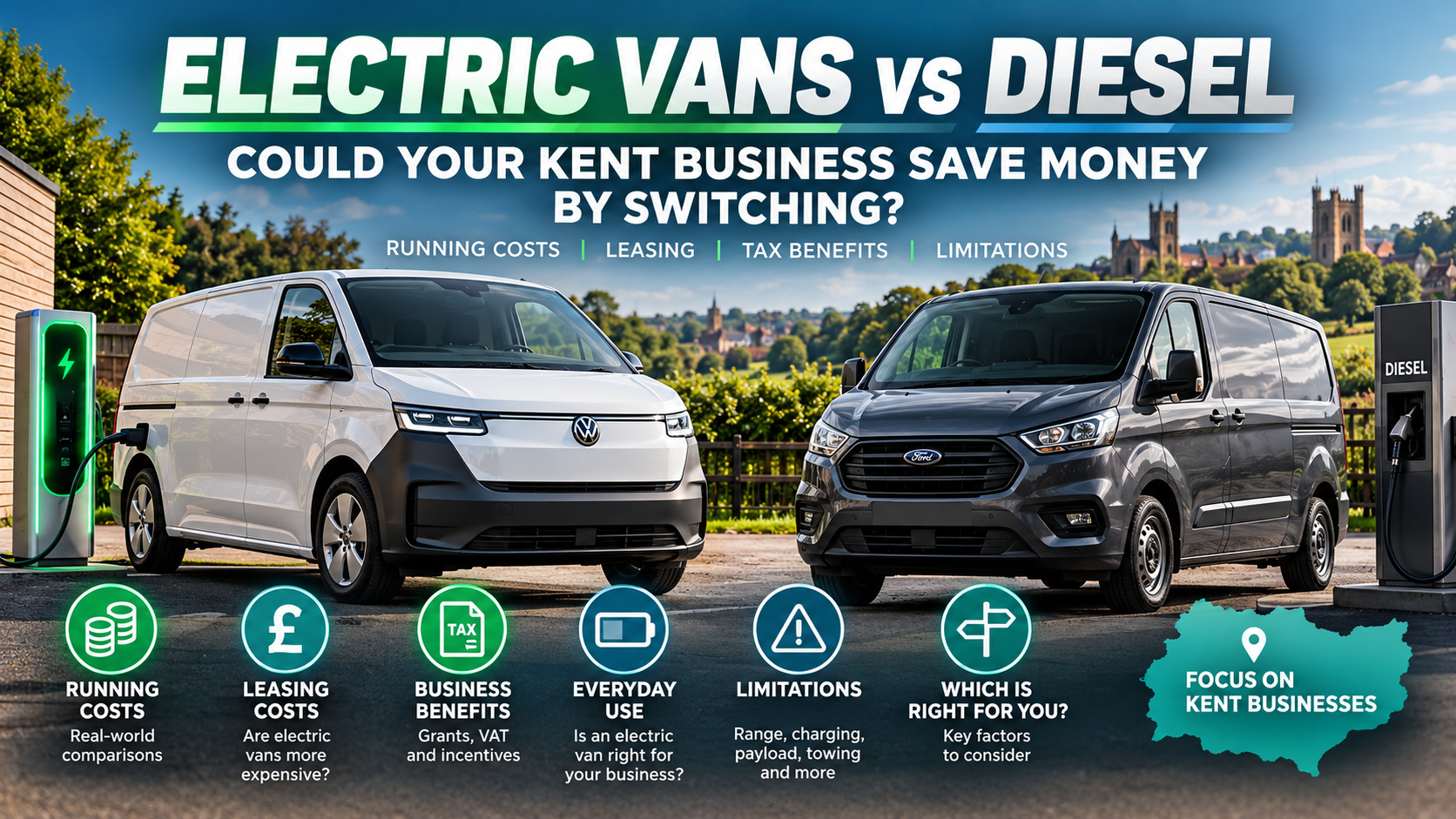
Electric Vans vs Diesel: Could Your Kent Business Save Money by Switching?
With more electric vans appearing on UK roads, many small business owners across Kent are asking the same question: Could switching from diesel or petrol to electric actually save my business money?
For electricians, plumbers, builders, delivery companies and other local businesses, choosing the right van can make a significant difference to running costs.
But while electric vans offer some compelling advantages, they’re not necessarily the right choice for everyone.
Neal Page from Kent-based Horizon Vehicle Leasing looks at the real costs, benefits and limitations to help local businesses make an informed decision.
How Much Does an Electric Van Cost to Run?
One of the biggest attractions of an electric van is the potential saving on fuel.
To illustrate the difference, let’s compare two typical medium-sized vans covering 15,000 miles annually.
| Running cost | Diesel van | Electric van |
|---|---|---|
| Annual mileage | 15,000 | 15,000 |
| Efficiency | 35 mpg | 2.5 miles/kWh |
| Diesel/electricity price | £1.50/litre | 20p/kWh |
| Cost per mile | 19.5p | 8p |
| Annual energy cost | £2,922 | £1,200 |
Potential annual saving: approximately £1,722 on fuel or electricity alone.
Over a four-year period, that could represent nearly £6,900 in energy savings.
These are illustrative figures rather than guaranteed savings. Actual costs depend on the vehicle, driving conditions, electricity tariff and charging arrangements.
A business with access to cheaper overnight electricity could save considerably more, while relying heavily on expensive public rapid chargers could reduce or even eliminate the advantage.
But What About the Monthly Leasing Cost?
This is where things become more interesting.
Electric vans can sometimes carry a higher monthly leasing cost than their diesel equivalents, although competitive manufacturer offers can narrow the gap considerably.
For example, if an electric van costs £60 more per month to lease, that’s an additional £720 annually.
However, using our example above, the business could still be approximately £1,000 better off each year after accounting for the additional lease cost and energy savings.
The important thing is to compare the total cost of running the vehicle, rather than simply choosing the lowest advertised monthly rental.
At Horizon Vehicle Leasing, we regularly help businesses compare different manufacturers, fuel types and leasing arrangements to find a vehicle that suits both their work and their budget.
Are Electric Vans Suitable for Everyday Business Use?
For many businesses operating locally across Kent, electric vans can make excellent sense.
Consider an electrician based in Maidstone who regularly visits customers in Tonbridge, Ashford and surrounding towns.
If the van covers 60–100 miles daily and can be charged overnight, an electric model may comfortably meet those requirements without disrupting the working day.
Electric vans also offer several practical advantages:
- No exhaust emissions while driving.
- Quiet, smooth driving, particularly useful in towns.
- Fewer routine servicing requirements associated with the electric drivetrain.
- Potentially lower energy costs when charged at home or business premises.
- Automatic transmission, making stop-start traffic easier.
For businesses with predictable daily routes, the transition to electric can be relatively straightforward.
What Are the Disadvantages of Electric Vans?
Despite the benefits, there are important limitations to consider before switching.
1. Driving range
An electric van’s real-world range can be significantly lower than its official figure, particularly during winter or when carrying heavy loads.
Businesses covering long distances or making unpredictable journeys need to consider this carefully.
2. Charging facilities
Having access to reliable overnight charging can make a substantial difference.
If your business operates from premises without dedicated parking or charging facilities, running an electric van may be less convenient and more expensive.
3. Payload and towing
Some electric vans have lower payload capacities than comparable diesel models because of the additional battery weight.
For builders, landscapers and other businesses carrying heavy equipment, checking the permitted payload and towing capacity is essential.
4. Time spent charging
A diesel van can be refuelled in minutes.
An electric van may require considerably longer, depending on the battery, charger and available charging power.
For businesses where the vehicle is constantly on the road, this could affect productivity.
5. Overall leasing costs
Although electricity may be cheaper than diesel, the monthly rental, insurance, charging installation and other operating costs must also be considered.
An electric van isn’t automatically the cheapest option.
Are There Government Incentives for Electric Vans?
Eligible new zero-emission vans can benefit from government support through the Zero Emission Van Grant, subject to the scheme’s rules and available funding.
Grant eligibility and amounts can change, and any support may already be reflected in the vehicle’s advertised price or leasing calculation.
Businesses should also consider vehicle taxation, VAT treatment and any relevant charging infrastructure costs when comparing options.
For the latest information, visit the UK Government’s guidance on zero-emission van grants.
Should Your Business Choose Electric, Diesel or Petrol?
There isn’t one answer that works for every business.
An electric van may be particularly attractive if you:
- Travel relatively predictable distances each day.
- Primarily work locally across Kent.
- Have access to affordable overnight charging.
- Want to reduce fuel expenditure and exhaust emissions.
A diesel van may remain the more practical option if you regularly travel long distances, tow heavy equipment or operate in locations where charging is difficult.
Petrol vans can also be worth considering for some lower-mileage businesses, although the choice of models is more limited.
The key is to understand how your business actually uses its vehicles before committing to a lease.
Local Advice From Horizon Vehicle Leasing
Based in Marden, Kent, Horizon Vehicle Leasing helps businesses throughout Kent and across the UK find competitive leasing arrangements on new commercial vehicles.
Whether you’re looking for a small electric delivery van, a medium-sized diesel van or a larger commercial vehicle, the team can compare options from multiple manufacturers.
Unlike dealing with a large call centre, Horizon offers a personal service, taking time to understand your business requirements, annual mileage and budget.
Thinking about replacing your business van?
Explore Horizon’s van leasing options in Kent, including electric and diesel vehicles, or speak directly with Neal and the team about finding the right van for your business.
Horizon Vehicle Leasing
Telephone: 01233 754800
Website: www.horizonvehicleleasing.co.uk
Back


Proud sponsors and supporters of

Active Business Group (ABG) Networking Association, Cave Hotel and Golf Resort, Boughton Golf Course, Brickfield Lane, Boughton-under-Blean, Faversham, Kent ME13 9AJ
Tel: 01795 500 399 E-mail: enquiries@activebusinessgroup.co.uk